The PROCESS acronym provides a step-by-step guide to crafting AI prompts that yield high-quality, relevant results. Each element ensures the AI understands your intent, constraints, and desired output, making it particularly useful for busy educators in resource-limited settings like Uganda’s schools. For instance, it can help create lesson plans that incorporate local contexts and promote active learning.
Benefits for Teachers
By using PROCESS, teachers can save time on planning while fostering creativity. It encourages prompts that go beyond generic responses, incorporating real-life examples to make lessons engaging. However, it’s important to approach AI as a supportive tool, not a replacement, and to review all generated content.
Practical Tips
Start with simple prompts and refine them based on results. Include specifics like grade level or curriculum standards to get targeted outputs. For more ideas, explore resources like AI for Education’s prompt libraries.
The rise of artificial intelligence (AI) in education has opened new doors for teachers, allowing them to streamline lesson planning, create customized resources, and enhance student engagement. However, the key to unlocking AI’s full potential lies in how we communicate with it—through well-crafted prompts. Poor prompts often lead to vague or irrelevant outputs, while structured ones can produce precise, actionable results. This is where the PROCESS framework comes in: a comprehensive approach to designing “perfect” AI prompts tailored for educators.
Developed as an original tool to empower teachers, especially in contexts like Uganda’s education system where resources may be limited, PROCESS stands for Persona, Result, Objective Details, Standards, Constraints, Structure, and Examples. It builds on established prompting best practices, such as those outlined in frameworks like CARE (Context, Ask, Rules, Examples) or the Atlassian guide‘s emphasis on Persona, Task, Context, and Format, but expands them into a holistic acronym that’s easy to remember and apply. By following PROCESS, educators can generate materials that align with curricula, promote critical thinking, and incorporate real-life relevance, all while ensuring ethical use.
Breaking Down the PROCESS Framework
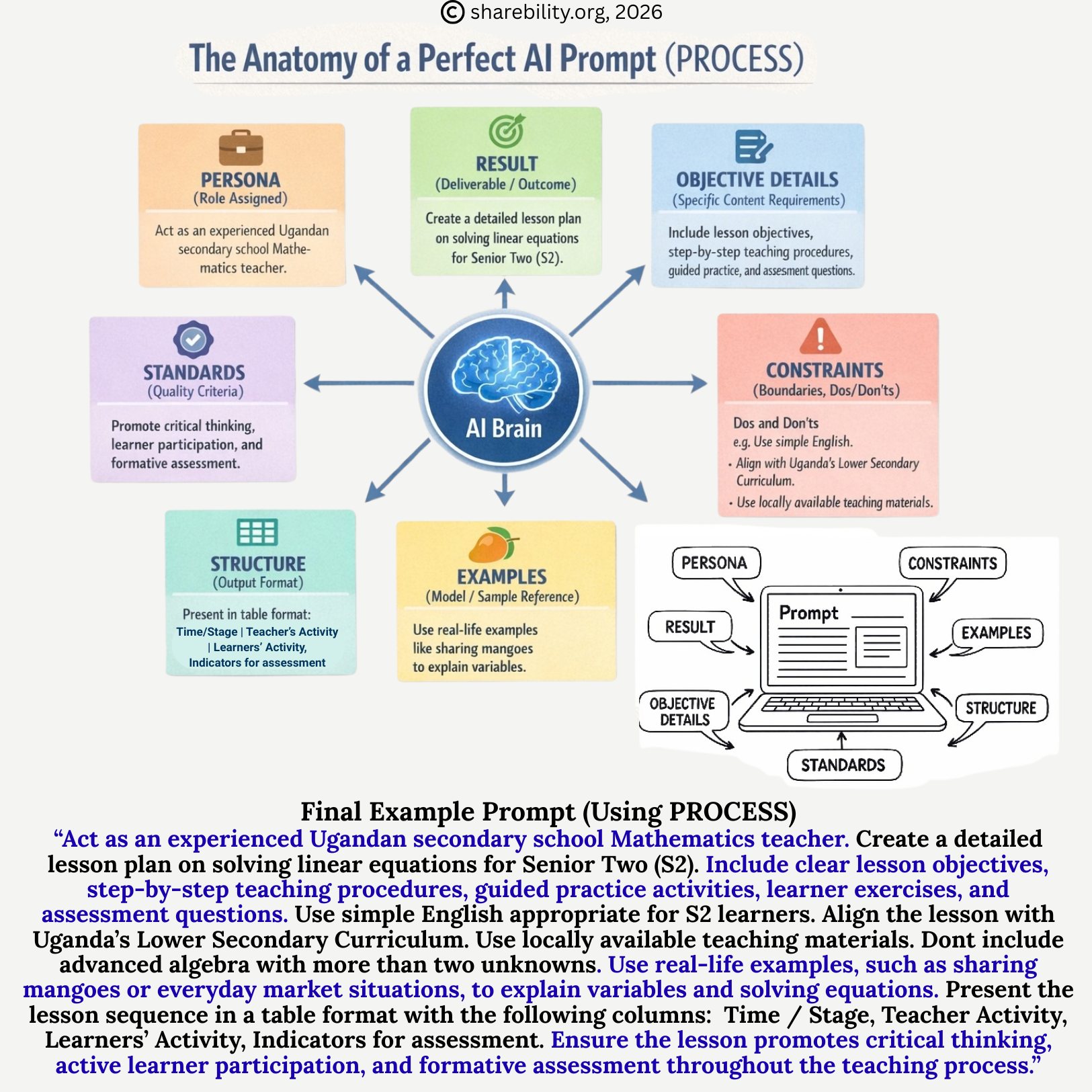
At its core, PROCESS treats an AI prompt like a detailed lesson plan: it assigns a role, defines goals, and sets boundaries to guide the AI toward meaningful outputs. The framework is visualized in the accompanying illustration, which depicts an “AI Brain” at the center, surrounded by the seven components radiating outward like spokes on a wheel. This diagram highlights how each element interconnects to form a cohesive prompt.
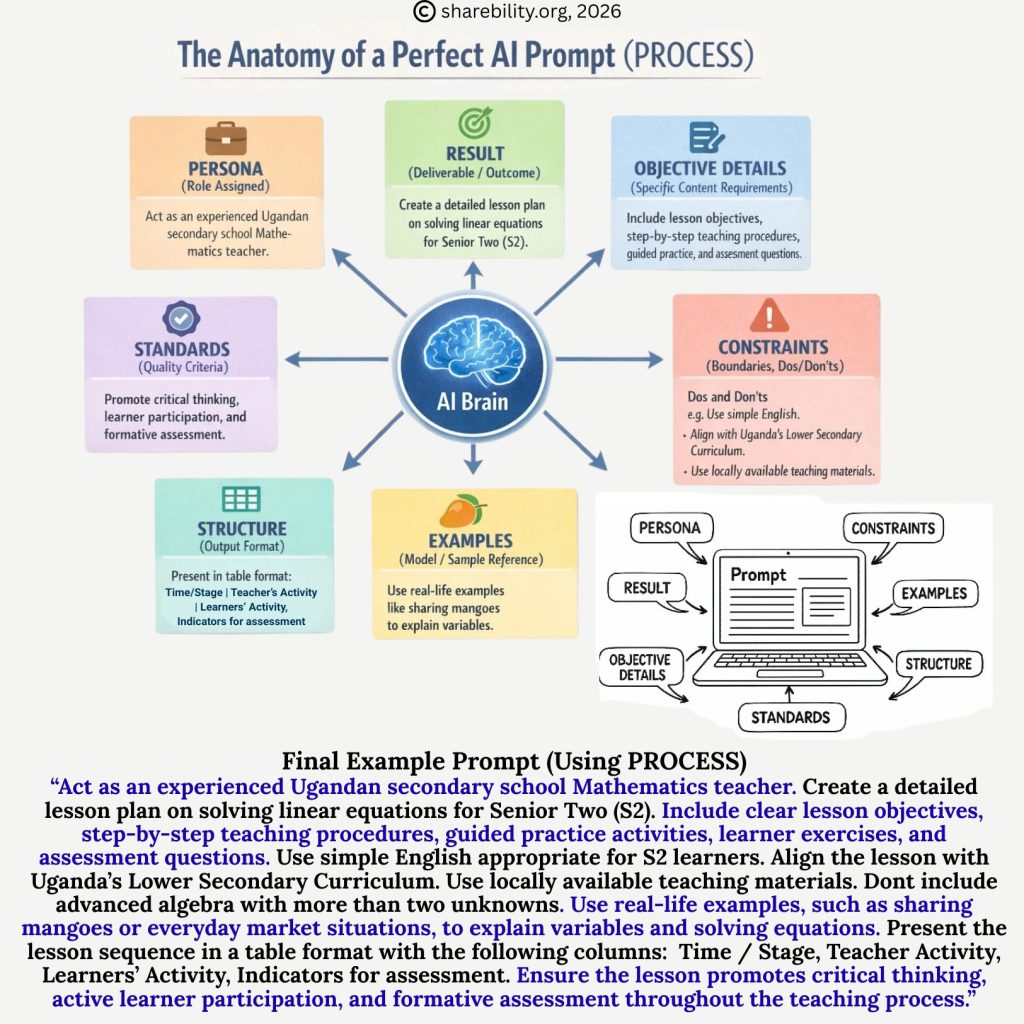
Here’s a detailed table summarizing each component of PROCESS, including descriptions, purposes, and educational applications:
| Component | Description | Purpose | Educational Application Example |
|---|---|---|---|
| Persona (Role Assigned) | Define the AI’s role, such as “an experienced Ugandan secondary school Mathematics teacher.” | Helps the AI adopt a specific perspective, ensuring responses are relevant and expert-level. | Use for generating content from a teacher’s viewpoint, like creating culturally attuned explanations. |
| Result (Deliverable/Outcome) | Specify the desired output, e.g., “Create a detailed lesson plan on solving linear equations.” | Focuses the AI on the end goal, reducing ambiguity and irrelevant details. | Ideal for producing ready-to-use resources, such as worksheets or activity guides. |
| Objective Details (Specific Content Requirements) | Include lesson objectives, step-by-step procedures, guided practice, and assessment questions. | Provides granular instructions to make the output comprehensive and targeted. | Ensures lessons cover key skills, like step-by-step teaching for complex topics in math or science. |
| Standards (Quality Criteria) | Promote critical thinking, learner participation, and formative assessment. | Sets quality benchmarks to encourage high-value, thoughtful responses. | Aligns outputs with educational standards, fostering active learning and evaluation methods. |
| Constraints (Boundaries, Dos/Don’ts) | Outline limits, such as “Use simple English, align with Uganda’s Lower Secondary Curriculum, don’t include advanced algebra with more than two unknowns.” | Prevents off-topic or inappropriate content, keeping responses feasible and appropriate. | Useful for adapting to local resources, avoiding overly complex materials in under-resourced schools. |
| Structure (Output Format) | Define the format, like “Present in table format: Learning Outcome | Aids | References |
| Examples (Model/Sample Reference) | Provide real-life examples, such as “Use real-life examples, such as sharing mangoes or everyday market situations.” | Illustrates concepts to make the AI’s output more relatable and explanatory. | Enhances student understanding by tying abstract ideas to familiar scenarios, boosting engagement. |
This table not only breaks down PROCESS but also demonstrates how it can be applied practically. For comparison, similar frameworks like REFINE (Role, Expectations, Format, Instructions, Narrow, Examples) emphasize role assignment and narrowing constraints, which overlap with PROCESS’s Persona and Constraints. However, PROCESS uniquely integrates Standards for quality assurance, making it particularly suited for educational contexts where promoting critical thinking is paramount.
A Real-World Example Using PROCESS
To see PROCESS in action, consider this final example prompt from the illustration:
“Act as an experienced Ugandan secondary school Mathematics teacher. Create a detailed lesson plan on solving linear equations for Senior Two (S2). Include clear lesson objectives, step-by-step teaching procedures, guided practice activities, learner exercises, and assessment questions. Use simple English appropriate for S2 learners. Align the lesson with Uganda’s Lower Secondary Curriculum. Use locally available teaching materials. Dont include advanced algebra with more than two unknowns. Use real-life examples, such as sharing mangoes or everyday market situations, to explain variables and solving equations. Present the lesson sequence in a table format with the following columns: Time / Stage, Teacher Activity, Learners’ Activity, Indicators for assessment. Ensure the lesson promotes critical thinking, active learner participation, and formative assessment throughout the teaching process.”
This prompt yields a structured lesson plan that’s culturally relevant, pedagogically sound, and ready for the classroom. see below the output of the prompt in grok:
It demonstrates how PROCESS turns a vague idea into a precise request, resulting in outputs that save teachers time while enhancing learning outcomes. In practice, educators can iterate on AI responses—refining prompts based on initial results, as recommended in best practices from AI for Education, which stress clarity, specificity, and feedback loops.
Best Practices for Teachers Implementing PROCESS
Drawing from broader research on AI in education, here are expanded tips to integrate PROCESS effectively:
- Start with Clarity and Specificity: As highlighted in Columbia University’s AI guides, be explicit about objectives and audience. For teachers, this means including grade levels, subjects, and standards to avoid generic content.
- Incorporate Ethical Considerations: Always verify AI outputs for accuracy, bias, and appropriateness. Frameworks like those from Packback emphasize using AI to support, not replace, student thinking—prompt for activities that encourage analysis rather than direct answers.
- Iterate and Refine: Treat prompting as a conversation. If the first output isn’t ideal, provide feedback like “Make it more engaging for visual learners” to improve results, aligning with conversational tips from Atlassian.
- Align with Curriculum and Local Contexts: Use PROCESS to create resources that leverage local curriculum and examples, as seen in the mango-sharing scenario. This fosters relevance and inclusivity.
- Train and Collaborate: Schools can adopt a training plan to build teacher confidence, starting with basics like specificity and structure.
- Explore Prompt Libraries: Resources like Common Sense Education’s AI tips offer libraries of educator-focused prompts. Adapt them using PROCESS for personalization.
- Measure Impact: Track how AI-generated materials affect student participation and outcomes.
Potential Challenges and Solutions
While PROCESS streamlines prompting, challenges like AI hallucinations (fabricated facts) persist. Counter this by cross-verifying with reliable sources and using warnings in prompts, similar to the “Warnings” component in Medium’s anatomy guide. Additionally, in low-connectivity areas, offline AI tools or pre-planned prompts can maintain accessibility.
In controversial topics, such as integrating AI ethically in assessments, balance views by prompting for pros and cons, ensuring diplomatic outputs that acknowledge debates around AI’s role in education.
Conclusion: Empowering Educators with AI
The PROCESS framework represents a powerful, educator-centric approach to AI prompting, enabling teachers to create dynamic, curriculum-aligned resources efficiently. By incorporating elements like real-life examples and quality standards, it not only saves time but also elevates teaching quality. As Sharebility Uganda continues to champion digital transformation in education, frameworks like PROCESS can help bridge gaps, fostering a more empowered learning environment. Experiment with it in your next lesson planning session—start small, refine as needed, and watch AI become a true ally in the classroom.